
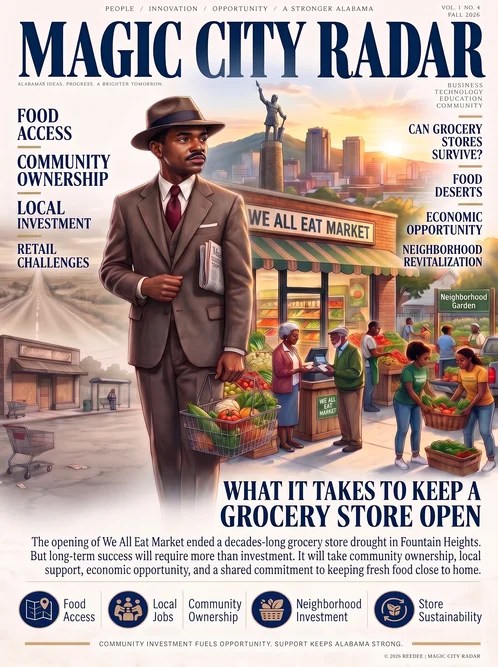
The opening of We All Eat Market in Fountain Heights ends a decades-long grocery store drought, but community leaders say long-term success will require more than investment. It will take community support, economic opportunity, and shared responsibility.
Written by: Magic City Radar
Part 1: The Victory
For the first time in decades, residents of Birmingham’s Fountain Heights neighborhood could walk into a grocery store without leaving their community.
On the morning of Saturday, November 7, a crowd packed into a two-story building at 1201 16th Street North to watch a ribbon fall — and to walk, for the first time in decades, into a grocery store of their own.
We All Eat Market sits inside the Heart of the Farm, the new home of Fountain Heights Farms Cooperative, in a neighborhood where two generations of families have done their grocery shopping somewhere else. M. Dominique Villanueva, who founded the cooperative with her husband, Christopher Gooden, said it plainly at the opening:
“For almost 70 years, you lived in Fountain Heights and you needed groceries, you had to leave. You had to find a ride or catch a bus, or take a long walk, or do without. But that ends today. This is not a store that came to Fountain Heights. This is a store from Fountain Heights.”
Gooden has seen what those years asked of people. “We’ve seen elders carry their groceries from bus stop to bus stop until they get home,” he told WBHM. The new market was built so that sentence could retire.
Jefferson County Commissioner Sheila Tyson, looking over shelves stocked with fresh fruits and vegetables, gave the morning its headline: “This is our version of Whole Foods!”
The store earned the comparison the slow way. It began in 2016 as a garden in the founders’ front yard, planted because the neighborhood had no fresh produce to speak of. The garden became a free stand, stocked with vegetables, canned goods, toiletries and clothes for whoever needed them. The stand became a Community Supported Agriculture program — the first in Alabama able to accept EBT and participate in the Double Bucks program. One garden became sixteen farm plots scattered across the neighborhood: mushrooms down the street, hibiscus two blocks over, collards and kale a couple of blocks the other way, pumpkins across from Tuggle Elementary, grown for the kids.
In 2021, neighbors raised $30,000 in small grassroots contributions to prove the demand was real. The City of Birmingham put $150,000 behind the project. At the grand opening, Commissioner Tyson pledged another $25,000 and District 9 Councilor LaTonya Tate pledged $40,000, following $17,000 she had presented the year before to give fifty families access to the farm’s CSA program.
What the money built is deliberately more than a store. The market sells produce from the cooperative’s sixteen plots and from fellow farmers across Alabama, including Tuskegee and Greene County. There are bulk bins of grains and beans, fresh herbs grown by Gooden behind the cash register, dry goods and household staples. Upstairs and alongside are a commercial kitchen where local chefs and food entrepreneurs can rent professional space, and the free stand — still stocked, still free. The market accepts SNAP, and through Auburn University’s Double Up Bucks program, eligible shoppers get fifty percent off certain produce. Mayor Randall Woodfin put the principle in one line: “Access to fresh, healthy food shouldn’t depend on your ZIP code.”
And then Villanueva, in the middle of the celebration, said the quiet part out loud. After the grand opening, she reminded the crowd, the community will need to spread the word about the new store — and support it year-round.
That is the part of the story nobody can ribbon-cut.
Part 2: The Hard Truth
Fountain Heights remembers having a grocery store worth fighting over — because it once fought over one, in the street, in front of the whole city.
In April 1957, Liberty Super Market opened at 420 13th Street North: 60,000 square feet, eighteen checkout lanes, an in-house bakery, and what it proudly billed as the South’s largest dairy department. Nine years later, in February 1966, the Southern Christian Leadership Conference organized mass protests at that store, demanding it hire the Black customers it depended on. That is how central a grocery store stood in this neighborhood’s life — provider, employer and battleground in a single building.
The Liberty is gone now; a credit union stands on the site, and no one marked the year it finally closed. What followed it is documented well enough: nothing. No supermarket ever took its place. To understand what We All Eat Market is up against, you first have to understand that the drought was not an accident of geography. It was built.
Fountain Heights endured decades of disinvestment, accelerated by housing discrimination and by the construction of Interstate 65, routed deliberately through the predominantly Black neighborhood. As the highway cut the community apart, property values fell. And where property values fall, retail follows them out. What remained, for decade after decade, were corner stores — Omar’s Discount, across the street from the farm, is the longtime survivor — selling snacks, sodas and packaged food, with very little fresh produce. The neighborhood did not lose its grocery store because its people stopped eating. It lost its store because the economics were dismantled around it.
Fountain Heights is not alone. Across Birmingham, residents have long discussed access to fresh food, quality grocery options, and the challenge of attracting and sustaining neighborhood-serving retail. The questions facing We All Eat Market are questions other communities are watching closely as they search for ways to strengthen local economies and improve food access.
Those economics have not gotten kinder. They are, in fact, some of the most unforgiving in American business.
According to FMI, the food industry association, the average food retailer keeps a net profit of about 1.7 percent of sales — less than two cents on every dollar that crosses the register. Out of those two cents come rent, wages, utilities, insurance, refrigeration, spoilage and everything else it takes to keep the lights on and the milk cold.
Now set that beside the other number. The National Retail Federation’s national security survey puts average retail shrink — merchandise paid for but never sold, lost to theft, process errors, damage and spoilage — at 1.6 percent of sales. Roughly two-thirds of it is theft, internal and external. Retail shrink includes a range of losses, including theft, damaged products, administrative errors, and inventory issues. Read those two figures together and the whole industry comes into focus: the ordinary rate of loss in a grocery store is nearly the size of its entire profit. A store does not have to be robbed blind to die. It only has to leak, steadily, at a rate its margin cannot absorb.
That is arithmetic, not accusation. It applies to a chain supermarket in the suburbs exactly as it applies to a cooperative market on 16th Street North — except that the cooperative carries weights the chain does not. A national chain negotiates prices with a buying power a sixteen-plot farm cooperative cannot match, as WBHM’s reporting noted. We All Eat has promised to do three hard things at once: keep food affordable for the neighbors, pay local farmers fairly for what they grow, and remain financially sustainable itself. It operates under rules written for traditional retailers — urban farms, for instance, cannot cut and sell meat on site. It serves families whose food budgets rise and fall with forces far from Fountain Heights, in a season when, as the cooperative itself noted at the opening, rising grocery prices and SNAP interruptions have made food access less certain for many families.
None of this is an argument against the store. It is the honest description of the ground it stands on — and it is why the question in Fountain Heights is no longer how to get a grocery store. It is how to keep one.
Part 3: The Solution
Christopher Gooden tells a story about the free stand.
When the cooperative first set it out — fresh vegetables, canned goods, whatever the harvest offered, free to anyone — people came and took everything. “I saw people come first and hoard and go up the street with everything off the table,” he said. Any retailer could tell you what that means. But the cooperative kept harvesting, and kept reloading the stand, week after week. And then something changed. “Over the weeks to come, as we kept harvesting and reloading the free stand, I saw people come and take what they need and leave the rest for everybody else. That’s the fuel that I stand on.”
Hold that story up against the arithmetic of Part 2 and you have the whole answer. A grocery store cannot survive on need alone. It survives when residents, business owners, and local leaders all have a stake in its success. Fountain Heights has already rehearsed, at a folding table full of free vegetables, the exact discipline a grocery store runs on: take what you need, leave the rest for everybody else, and keep the table standing for the next neighbor.
The long-term sustainability of neighborhood grocery stores depends on several factors working together: customer support, competitive pricing, public safety, local hiring, access to assistance programs such as SNAP, and a business model capable of surviving on thin margins.
The cooperative has built that stake into the structure of the thing itself. This is not a store that parachuted in with a corporate flag. Neighbors run it — the market and farm together employ local people, with more opportunity promised as operations grow. Local farmers stock it, from the cooperative’s own plots to growers in Tuskegee and Greene County, so the dollar a Fountain Heights family spends on collards has a chance to stay in the region instead of leaving with the shopper, the way grocery dollars left this neighborhood for decades. Residents are being invited further in still — toward participation in ownership, sharing in the economic benefit of the food system they are building. The Freedom Harvest Apprenticeship trains new farmers over nine paid months to lead production on urban farms. The goal on the wall is 119 farm plots by 2030.
The public stake is real, too: a city’s $150,000, a county commissioner’s pledge, a councilor’s checks, an Urban Impact pipeline that helped with business plans back when this was still a front-yard garden. And the household stake is engineered with care — SNAP accepted, produce half off through Double Up Bucks, prices held down on one side and farm incomes held up on the other, because a store the neighborhood cannot afford to shop in is just a monument.
What remains is the simplest and hardest part: the daily decision, repeated by thousands of households, to buy the groceries here — to make the neighborhood store the first stop instead of the emergency stop, to spread the word the way Villanueva asked, and to treat the place the way people learned to treat the free stand. When we feed one another, Cicely Garrett of the National Black Food and Justice Alliance said at the opening, we weaken the ability of scarcity to govern us.
The opening of We All Eat Market is more than the arrival of a grocery store. It is a test of whether a community can reclaim control of its food system and support a business built to serve its own residents. For Fountain Heights, the challenge is no longer attracting a grocery store. The challenge now is ensuring that one remains for decades to come. The market is where that sentence gets tested, one shopping trip at a time.
We All Eat Market, 1201 16th St. N, Birmingham — open Tuesday through Saturday, 7 a.m. to 7 p.m., and Sunday, 10 a.m. to 7 p.m.

