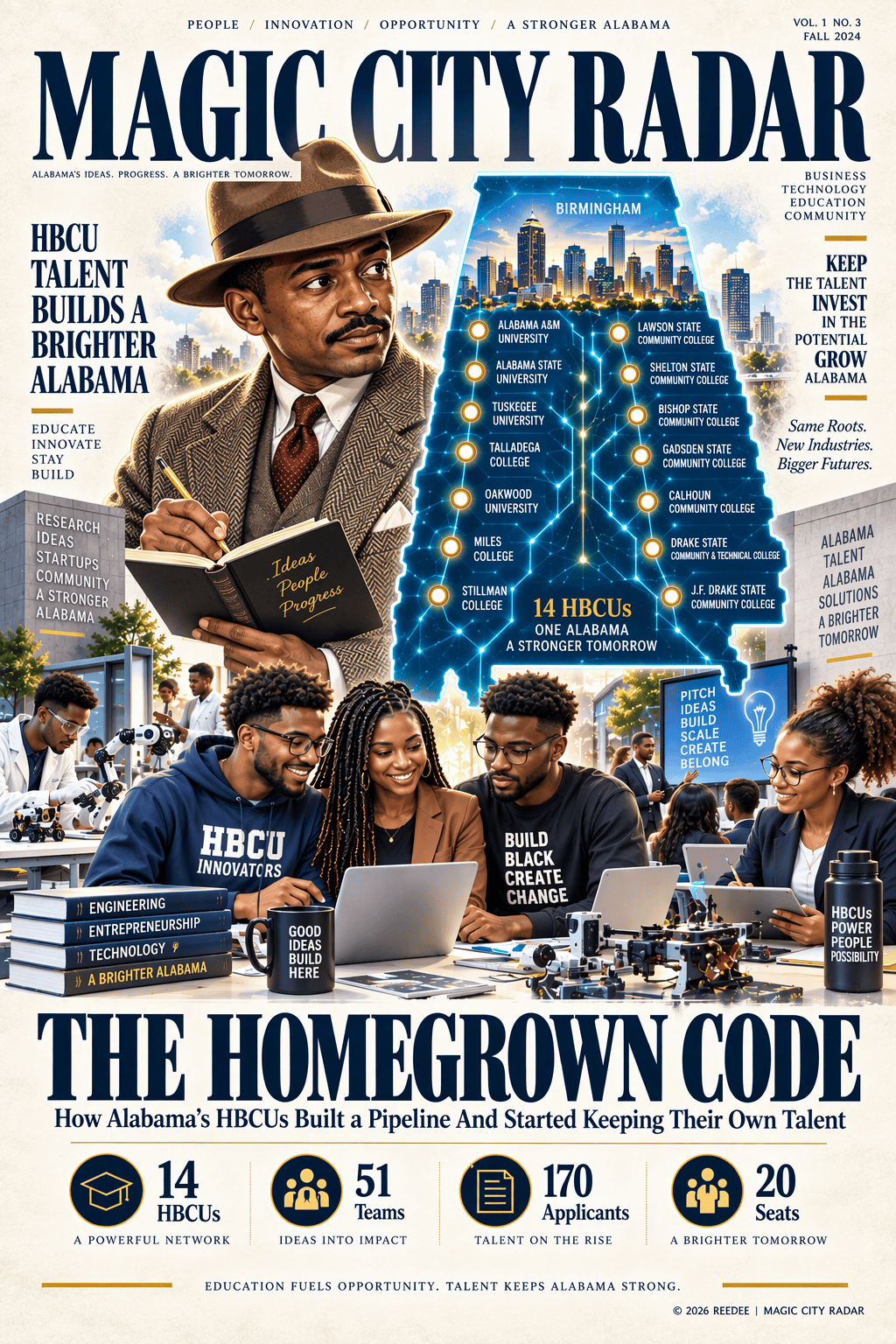
How Alabama’s HBCUs Built a Pipeline — and Started Keeping Their Own Talent
Magic City Radar — Cover Story
Classic weekend in Birmingham runs on two fuels: football and family. The bands, the tailgates, the purple and gold and maroon and white — that part everybody knows. But on Thursday night, October 29, while the city was still warming up for Alabama A&M and Alabama State at Legion Field, the most consequential competition of the weekend wasn’t on any field. It was at Topgolf, and the weapon of choice was a pitch deck.
Fifty-one teams. Ten of Alabama’s fourteen HBCUs — and understand, Alabama has more HBCUs than any state in the nation, fourteen deep, from Huntsville to Mobile. Students, faculty, and alumni, all of them carrying the same cargo: an idea they believed could be a business, and the nerve to stand up in front of judges and say so out loud.
When the night was over, the biggest check in the room belonged to a 21-year-old mechanical engineering student from Alabama A&M named Bryson Hannah. His company is called Internably, and it was born out of a loneliness anybody who has ever interned in a strange city knows by heart: you land in a corporate apartment in a town where you know no one, and the loneliest hours of your professional life are the ones after work. Internably groups interns by city, by employer, by school, and turns that isolation into community. The judges gave it the grand prize — $4,000 — on top of $1,000 Hannah’s team had already banked in the first round. Five thousand dollars, and here is the detail that tells you who this young man is: he isn’t spending it on himself or even, mainly, on the app. He is spending it on people — campus ambassadors, students at schools across the country who will carry Internably onto their campuses ahead of its iOS launch this month. He is an engineer by training, bound for transmission line design. He is building power lines of another kind on the side.
That is the heart of this story. Now let’s talk about the machinery underneath it, because the machinery is the point.
Count it
Sentiment is fine, but documentation is power. So let’s count.
The 2026 HBCU Business Pitch Competition, co-hosted by The Alabama Collective and digitalundivided and backed by the JPMorganChase Foundation, HBCU C.A.R.E.S., and Nebius, is in its fourth year. Four years is not an event. Four years is an institution forming. Ten teams walked out of the first round with $1,000 each. And when the finale came, the whole podium belonged to one school: behind Hannah’s Internably came Fuel Trip, built by A&M senior engineering majors Munachimso Arubaleze, Danylah Branch, and Bukata Mubanga, good for $3,000; and NexU, from A&M’s Amarachi Ezekiel, Omotolani Bello, and Osionela Ogiogwa, good for $2,000. Alabama A&M ventures collected $12,000 of the prize money on the night. A sweep like that is not luck. A sweep is what preparation looks like when it has a system behind it.
The system has a name — several, actually, and they interlock. The Alabama Collective works a four-word discipline: Expose, Educate, Engage, Empower. Exposure first, because you cannot aspire to a room you have never seen. Then there is FuelAL, the talent initiative of the Economic Development Partnership of Alabama, run in partnership with Innovate Alabama, whose HBCU Innovation Internship places students inside startups, accelerators, and research institutions for twelve paid weeks of real work. The Fall 2026 cohort, launched in August, put 17 students from six HBCUs — A&M, Alabama State, Lawson State, Stillman, Talladega, Tuskegee — into 13 employers, from HudsonAlpha’s biotechnology benches in Huntsville to Techstars and Analytical AI, each intern carrying a $3,000 stipend. The Spring 2026 cohort before them drew more than 170 applicants for roughly twenty seats. Read that ratio again. One hundred seventy applications for twenty chairs is not a program looking for interest. It is a generation pressing against a door.
Public and private, research university and liberal arts college, Huntsville and Montgomery and Tuskegee and Birmingham — the pipeline crosses every line that used to keep Alabama’s Black institutions resourced in isolation. That is the design. A student at Talladega, a private college of a few hundred, draws from the same venture mentoring and the same employer network as a student at A&M. The isolation was the tax. The network is the refund.
The argument underneath
For two generations, Alabama’s story about its brightest Black graduates has been a departure story. The talent is raised here, educated here — and harvested elsewhere. Atlanta takes its cut. Charlotte takes its cut. Silicon Valley takes the best of the rest, and the state that paid for the raising and the teaching watches the value compound somewhere else.
What EDPA and Innovate Alabama are attempting, with HBCU students specifically named as the talent pool, is to reverse the direction of the current: paid internships inside Alabama’s innovation economy, mentorship from people who have actually raised money and shipped product, pitch stages with real checks at the end of them. A fireside conversation at Topgolf that weekend put a JPMorgan Chase managing director, Brigitte Killings, in front of the students to talk about relationships — because the founders in that room understood the assignment. Capital follows networks. Networks can be built on purpose. These are being built on purpose.
Radar will give you the honest paragraph, because somebody should. Twenty thousand dollars in prize money and three-thousand-dollar stipends are seed, not soil. Atlanta’s gravity is real, and it compounds salaries, not stipends. A pitch competition proves students can start; the unproven question is whether Alabama can make them stay — whether the Series A gets raised in Birmingham, whether the FuelAL intern of 2026 is the Birmingham founder of 2030 or an Atlanta founder with an Alabama accent. The pipeline is built. Whether it empties into Alabama or through it is the story of the next ten years, and this page intends to keep counting.
But do not let the caveat eat the fact. The fact is that a state with fourteen HBCUs — the deepest bench in America — has stopped treating that as a trivia answer and started treating it as an economic strategy, with its Black colleges at the center of the design rather than the margins of it.
January
In January, the next FuelAL cohort walks through the door — applications for Spring 2027 closed in October, the stipend rises to $3,500 with college credit attached, and another class of students from Alabama’s Black colleges will sit down inside the state’s startups and laboratories and learn the rooms from the inside.
And somewhere in Huntsville, a 21-year-old engineer is spending his prize money the way his people have always spent their first real money: on bringing other folks with him. Ambassadors on campuses he may never visit, carrying a platform built to make sure no intern eats alone in a strange city again.
Fourteen schools. Fifty-one teams. One hundred seventy applicants for twenty chairs. The numbers say pipeline. What happened at Topgolf on Classic weekend says something older and simpler than that.
It says the talent was always here. Now the doors are, too.
Reporting drawn from The Birmingham Times, AfroTech, Black Enterprise, HBCU News, EDPA/FuelAL, and Alabama State University. Story tips: Magic City Radar.

