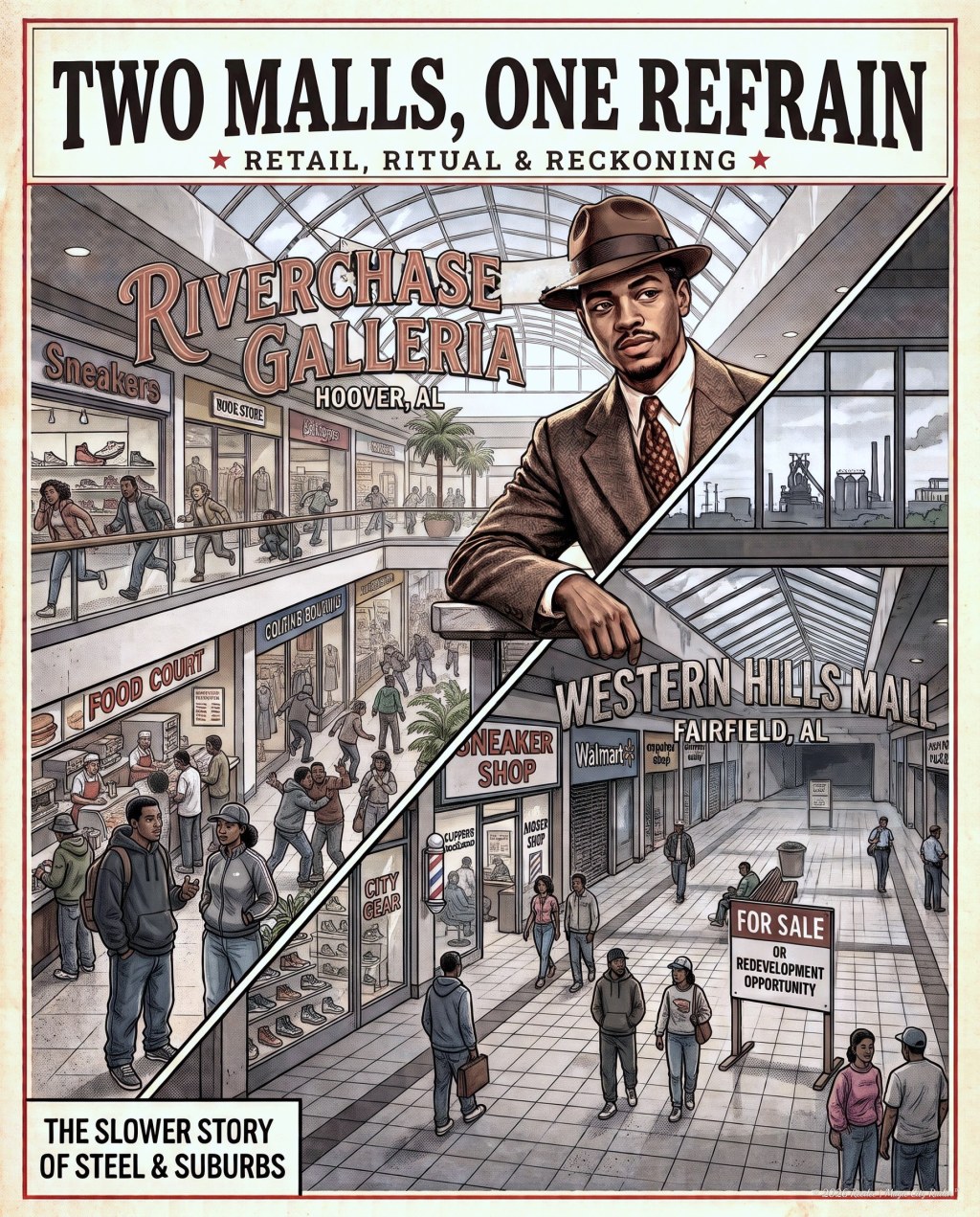
Riverchase Galleria is for sale. Western Hills is nearly empty. The gunfire makes the headlines, but the slower story — steel, suburbs, and what a mall means to the people who grew up inside it — is the one still being written.
Written by: Magic City Radar
The shots came a little before noon on Friday, in the food court at Riverchase Galleria, on the day before the Magic City Classic — which is to say, on one of the days when Birmingham is most fully itself, when the alumni are flying in and the tailgate supplies are being bought and the whole region is dressing for the biggest family reunion in Black college football. A fight between people who knew each other. One man shot in the arm, treated and released. A lockdown that lasted a little over an hour before the mall reopened and the weekend resumed.
By the numbers, it was a small shooting. That is precisely the point. At the Galleria, no shooting is ever only itself anymore. Each one arrives carrying the ones before it, the way a chorus in a blues comes back around — same refrain, new verse, and everybody in the room already knows the words.
Because this is what the record says. On Thanksgiving night in 2018, a fight on the upper level ended with an 18-year-old shot, a 12-year-old girl wounded as she fled, and — in the confusion that followed — a Hoover police officer shooting and killing Emantic “E.J.” Bradford Jr., a 21-year-old who was not the shooter at all but an armed young man moving toward the sound, as soldiers and sons are taught to do. Police named him the gunman, then took it back and apologized. The Attorney General ruled the killing justified; the family’s lawsuit ended, finally, in the Eleventh Circuit in 2025, with the courts siding with the officer. The actual gunman pleaded guilty in 2022. None of that bookkeeping has ever quite settled the account.
In June 2019, Zachariah Taylor Music, a 20-year-old UAB student, was found shot to death in his car on the fifth floor of the north parking deck — a robbery arranged around a drug deal, police said, targeted and planned, which did not make it any less a part of the refrain. And on July 3, 2020, in that same food court where Friday’s fight broke out, a feud between groups of young men turned into a dozen rounds fired in a matter of seconds, and one of those rounds found Royta Giles Jr., eight years old, of Bessemer, shopping with his family, and killed him. Three other bystanders were wounded. The convictions took years to assemble — guilty pleas to reckless murder carrying 30 and 25 years, a reckless manslaughter conviction that Alabama’s appeals court affirmed just this September — and the mall answered with gun-sniffing dogs and more officers within two weeks. Then came five quiet years. Friday broke them.
The Promenade
To understand why a shooting in a food court lands the way it does in Birmingham, you have to understand what a mall actually was — not the retail, the ritual. For two generations of Black Birmingham, the mall was the promenade: the climate-controlled main street of a region that had spent a century being told which streets were not for them. It was the first job and the school clothes, the Santa photos and the senior portraits, the place your grandmother took her walk in the morning and your cousin took his date at night. Sneaker releases, hair shows, church groups in matching shirts the week of the Classic. Commerce, yes — but commerce arranged as a gathering, which is the oldest Black technology there is: take the materials at hand and improvise a public square out of them.
That is why the decline of these buildings cannot be read off a leasing chart alone. When a mall dies in a Black community, a factory of memories dies with it, and the people who lose it lose something that was never listed among the assets.
The Survivor, Priced to Move
Riverchase Galleria opened in February 1986, the largest enclosed mall in Alabama, roughly a million and a half square feet of leasable space wrapped around a hotel and an office tower on the hill in Hoover — the suburb that money built when Birmingham’s money decided to move. For decades it was simply where the region shopped: Belk, JCPenney, Macy’s, and in 2013 Von Maur, in a sixty-million-dollar redevelopment that was supposed to announce a second act.
The second act has been harder than the announcement. Visits fell from 6.3 million in 2019 to 4.2 million in 2024. The Sears has been empty since 2019. The mall’s loan sits with a special servicer, and in January AL.com reported that the Galleria’s slump is costing Hoover millions in tax revenue. This past June, Brookfield put the property up for sale. A study commissioned for its future imagines a $240 million transformation — apartments, a performing arts center, green space where the department stores used to be. It is a proposal, not a plan, and no buyer has been announced. The Mayor of Hoover, who was the police chief on that Thanksgiving night in 2018, calls the listing a big opportunity, and says the city will be a strong and active partner in whatever comes next.
Notice what all of that means: Riverchase’s story was never only a violence story. The shootings punctuate it, terribly. But the bass line underneath — e-commerce, aging anchors, a suburban tax base learning to live with less — was playing before the first shot and would be playing if no shot had ever been fired. The Galleria has what economists call options and what everybody else calls a cushion: a wealthy city behind it, national anchors still in place, a hotel full of guests, land worth reimagining. Its question is not whether it survives. It is what it survives as.
The Mall That Steel Left Behind
Western Hills Mall, out on Aaron Aronov Drive where Fairfield meets Midfield, has no cushion. It never got one back after the first one was taken.
It opened in February 1970, Birmingham’s second enclosed mall, anchored by Loveman’s and JCPenney, in the years when the U.S. Steel works at Fairfield still paid the wages that filled its parking lots. When the steel economy collapsed, the mall’s economy went with it, verse by verse: the national chains gone by about 2000, Parisian in 2004, JCPenney in 2005. In 2006, Walmart demolished the old Penney’s, built a supercenter on the ground, and for a decade the largest retailer on earth was the mall’s lifeline — until January 2016, when Walmart closed too, and Burlington followed it out the door a year later, leaving the building with no anchors at all. What remained, and what remains, is a mall of independents — sneaker stores, clothing shops, furniture outlets — serving, in the main, the Black community around it, which kept coming not out of nostalgia but because it was theirs.
The violence there reads differently in the record, and the difference is instructive. At Western Hills the shootings arrive not as shocks to a healthy body but as blows to a frail one. In February 2016, a man who had argued with another shopper earlier came back armed and wounded two people. On February 15, 2018 — the same year as the Galleria’s Thanksgiving — Anthony “Tony” Alberigi, 59, the mall’s own manager, stood outside the north entrance in the afternoon holding his papers and a drink while two groups of young men recognized each other and opened fire, dozens of rounds, and he died on the sidewalk, a man killed at his workplace by a quarrel that had nothing to do with him. In 2020 came two parking-lot shootings, one in February, one in August in which a bystander fired back at the gunman in a stranger’s defense. In June 2023, three masked men shot 16-year-old Kentrel Jah’mar Miller to death in the parking lot in the middle of the afternoon; no arrest has ever been announced. And on a Sunday evening in February 2025, two groups traded words and then gunfire in the food court, and Darin Marquese Hall, 32, who was nobody’s target and everybody’s neighbor — an innocent bystander, the Sheriff’s office said plainly — was killed. A 19-year-old was charged with murder and attempted murder and held without bond.
Fairfield’s answer, such as a small city can give one, has been endurance and improvisation: a Miami firm bought the mall in 2022 for under three million dollars and put four million more into a roof, air conditioning, paint, and a resurfaced lot. It is back on the market now anyway, listed as a redevelopment play, barely a fifth of its rentable space leased, the city having rezoned the ground around it for the mixed-use future that every dead and dying mall in America is now promised. What is not on any listing sheet is the fact that people still get their hair done there, still buy the sneakers, still gather — that the ritual outlasted the economics, which is either the definition of faith or the definition of a community with nowhere else it is determined to be.
The Ground That Is Already Gone
Birmingham does not have to imagine how this ends; it has the photographs. Eastwood Mall, Alabama’s first enclosed mall, opened in 1960 and closed in 2004; a Walmart stands where it stood. Century Plaza, across the road, closed in 2009 and was demolished beginning in 2020, and where generations of east-side families once did their Christmas shopping there is now an Amazon delivery station — a building goods pass through and people do not, the exact negative image of a mall, logistics having replaced gathering as the region’s organizing idea. Brookwood Village, in wealthy Homewood, lost its last tenant at the end of 2024 and is becoming a medical complex, which may be the most honest sentence American retail has left: the mall is gone, the clinic is the future.
That is the real comparison, and it was never finally about which mall had more shootings. Riverchase and Western Hills are playing the same song in different keys — one with a city’s wealth behind it and a for-sale sign out front, one with a fifth of its space leased and a community’s memory holding it upright. In both, the gunfire is the part everybody hears. In both, the quieter verses — the anchor that left, the loan that soured, the wages that disappeared fifty years ago when the furnaces cooled — did most of the work.
On Friday afternoon, about an hour after the lockdown, the Galleria opened its doors again and the Classic weekend went on, because that is what this region does: it absorbs the verse and waits for the chorus, and it keeps gathering in the places it has left. The food court at Western Hills still serves lunch. The promenade is thinner than it was. It has not emptied.
The refrain, as always, is not whether the music stops. It is who keeps playing, and what they are playing on, and for how long the rest of us intend to let the gathering places of Black Birmingham be the last thing on the ledger anybody thinks to fund — and the first thing everybody mourns.

