Five Points West Has Heard the Speeches for Forty Years. Now Come the Bulldozers — and a Neighborhood Decides Whether to Believe Again.
Magic City Radar — Cover Story
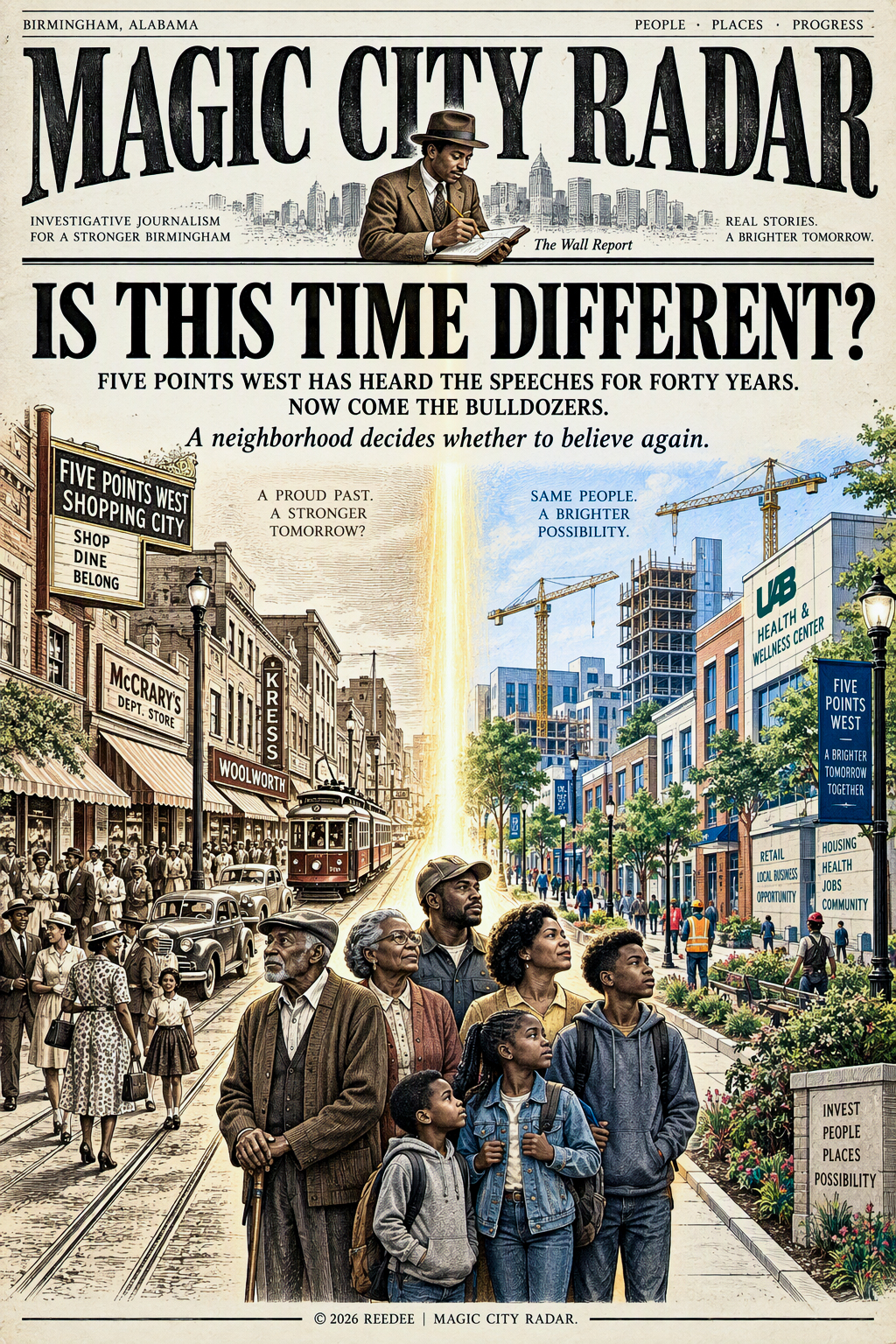
Ask anybody who grew up on Birmingham’s west side what Five Points West used to be, and watch their whole posture change. They don’t describe a shopping center. They describe a destination — the place you dressed for. Five Points West Shopping City on Bessemer Road drew Birmingham for the better part of a century: the fairgrounds crowds, the stores, the weekend current of people who had money in their pockets and every intention of spending it in their own neighborhood. Bessemer Road still carries some 22,000 cars a day. The road never forgot the route. It’s everything along it that was allowed to thin out.
That’s the first thing an outsider has to understand about this story. Five Points West is not a blank slate waiting for a vision. It is a place with a memory, and the memory is not ancient — it lives in people who can still point to where things stood. When a neighborhood like that watches another ribbon-cutting, it does not see a beginning. It sees a claim, and it grades claims against forty years of evidence.
The decline was not weather. It was not an act of God or a failure of the people who lived there. It was a long, documented withdrawal — retail following the suburbs, investment following the retail, and a commercial district that had anchored Black Birmingham’s west side left to make do with event traffic and promises. The CrossPlex, the city’s gleaming indoor track and aquatic center on the old fairgrounds site, brought the region’s athletes to the neighborhood’s doorstep — and for years the neighborhood’s complaint about it was precise: everybody drives in, everybody drives out, and the money changes hands somewhere else. A destination is not an economy. A Tuesday is an economy.
So the question hanging over every announcement in Five Points West, Ensley, and Pratt City is not how much and not how pretty. It is the question James Baldwin handed this country more than sixty years ago, when he looked at what cities were doing to Black neighborhoods and gave it its true name. Urban renewal, Baldwin said, means Negro removal. Every legacy resident who has ever watched a blueprint unroll across a folding table is asking some version of the same thing: Is this for us — or is this the next stage of our removal, with better landscaping?
Now the bulldozers are real, and the money is real, and the question deserves a real examination. Let’s lay the blueprint on the table and test it the way the neighborhood will.
What’s actually coming
Start with the headline project. The Birmingham Family Fun Center — a city-owned, $15 million, 35,000-square-foot facility at CrossPlex Village, on the grounds of the old Alabama State Fairgrounds — is designed as the centerpiece of a mixed-use development: indoor pickleball, bocce, multipurpose space, room for every generation under one roof. Mayor Woodfin announced the vision in 2022. The years since have taught the west side patience it did not ask for — timelines here have slipped before, and Radar will believe the opening date when the doors open. But the investment is voted, the operator is named, and the dirt is supposed to move.
Around it, quieter and arguably more important, the daily pieces are already landing. Eric Guster, a Birmingham attorney and developer — Black, local, and betting his own money — has built out the retail center at 2250 Bessemer Road, directly across from the CrossPlex, and leased it full, health tenants and all. A Jack’s stands on CrossPlex Boulevard. An ArchWell Health center serves the neighborhood’s seniors. The A.G. Gaston Boys & Girls Club’s Howlett Clubhouse — $7.2 million, with a teen center, a teaching kitchen, and a performance space — has been open on Avenue W since 2020, doing unglamorous daily work. The Valley Creek Trail extension is under construction to tie Midfield to the CrossPlex on foot and by bike. None of this is a rendering. All of it either exists or is funded.
And then there is the mirror the west side will hold up, because it cannot help itself. Across town, next to Railroad Park, Birmingham-born KultureCity is transforming the historic Powell Steam Plant into the world’s first National Accessibility Park — a $60 million campus with a technical college built to train and place people with disabilities, a museum, an amphitheater, sensory-inclusive everything. The city put in $7 million; the county, $3.5 million; KultureCity is raising and investing the rest, and the doors are set for 2028. It is a magnificent project, founded by Birmingham people, and it is also a fact that the $60 million flagship landed downtown while the west side’s headline number is $15 million and a fun center. Nobody in Five Points West needs a spreadsheet to do that math. They will say the ratio out loud, and they will not be wrong to.
The test
So test the blueprint — not against the renderings, but against the four things that actually rewrite a neighborhood’s script.
One: daily anchors, not event traffic. The CrossPlex critique — in for the meet, out by dark — is answered only by commerce that serves a Tuesday: groceries, sit-down food, a bank, a doctor, a pharmacy. Guster’s fully leased center is the strongest evidence yet that daily retail can live on Bessemer Road again, precisely because it sells necessities to the people already there. The Fun Center, for all its virtues, is still destination square footage. It will help most if it drags daily anchors in behind it — and hurt the narrative if it becomes one more place the neighborhood watches other people enjoy.
Two: the broken windows get fixed, or nothing else matters. Blight is a message, and the west side has been receiving it for decades: overgrown lots, illegal dumping, tired roads, boarded commercial shells. Grassroots groups like The Movement Foundation in Ensley and Pratt City have said it plainly — code enforcement, demolition of the derelict, clean streetscapes, and working lights are not cosmetic. They are the prerequisite. A $15 million fun center beside an unpaved street is not a transformation; it’s a photograph. The city’s infrastructure follow-through in the surrounding blocks will tell residents more than any press release.
Three: the young people get a stake, not a spectacle. The Gaston Clubhouse model — teens working, learning, cooking, performing blocks from home — is the template. If the Fun Center and the new retail hire from the surrounding streets, train from the surrounding schools, and put west side teenagers behind the counters and on the management track, the social fabric moves. If the jobs commute in, the neighborhood is décor for somebody else’s opportunity.
Four: the wealth stays. This is the Baldwin test, and it is the whole ballgame. Legacy homeowners who weathered the worst decades cannot be taxed, priced, or bought out of the renaissance they waited for. Home-repair help for the people who stayed, micro-loans and first looks for local entrepreneurs in the new commercial spaces, Black developers like Guster at the table as principals and not tenants — that is what separates renewal from removal. The early returns are genuinely mixed into something like hope: the most convincing new retail on Bessemer Road is being built by a man from here. That fact should be policy, not luck.
The verdict belongs to the neighborhood
Radar is not going to grade this one from a desk, and neither should anyone else. Transformation will not announce itself at a groundbreaking. It will show up on an ordinary Tuesday, in whether the grocery run, the doctor’s visit, the paycheck, and the evening walk can all happen within the same few blocks — and in whether the people doing them are the people who never left.
Five Points West has heard the speeches for forty years. It has buried the fairgrounds era, outlasted the slide, and kept its own counsel about every promise made since. The blueprints on the table now are the most serious in a generation, and the skepticism they face is not cynicism — it is memory, doing its job.
Is this time different?
The west side will tell us. It always intended to grade the work itself.
Reporting drawn from Alabama News Center, VenuWorks, Bham Now, ArchWell Health, Bhamwiki, and Birmingham Parent. The interview layer — Five Points West, Ensley, and Pratt City residents, neighborhood leaders, and business owners — is being gathered for the published edition. Story tips: Magic City Radar.

