Birmingham’s police drones, the cameras that never blink, and the rules that have to come with both
Written by: Magic City Radar
Everybody in Birmingham knows how the last Saturday of October is supposed to end. Alabama A&M and Alabama State settle it on the field — 31 to 28 this year — and then the whole gathered family pours out of Legion Field into the night: the grills still smoking along Graymont Avenue, the music still going, grandmothers and babies and old classmates who found each other one more time. It is the largest family reunion in Black America, and it closes the way family closes, slow and loud and in no hurry to go home.
This year, shortly before eight o’clock, somebody started shooting into that family.
Nine people were hit in the 400 block of Graymont Avenue West. One died. Eight were wounded, one critically. Police recovered multiple firearms and took a 17-year-old into custody who, the mayor said, carried a gun fitted with a Glock switch. Two bursts of violence, minutes apart, in a crowd dressed for celebration.
Stay in those first minutes a moment, because everything in this argument lives there. When shots ring out in a crowd, nobody knows anything. Not the families ducking between the cars. Not the officers sprinting toward the sound. Where is it coming from? How many shooters? Which way is safe? In Birmingham, we know the sound of help coming — we have been listening for it, one way or another, all our lives. But help that arrives blind arrives late, and blindness in those minutes is where people get hurt: bystanders who run the wrong way, officers who have to read a scene by standing in the middle of it.
That is the ground this city’s newest argument stands on. It deserves to be argued from the ground up.
What the city is actually proposing
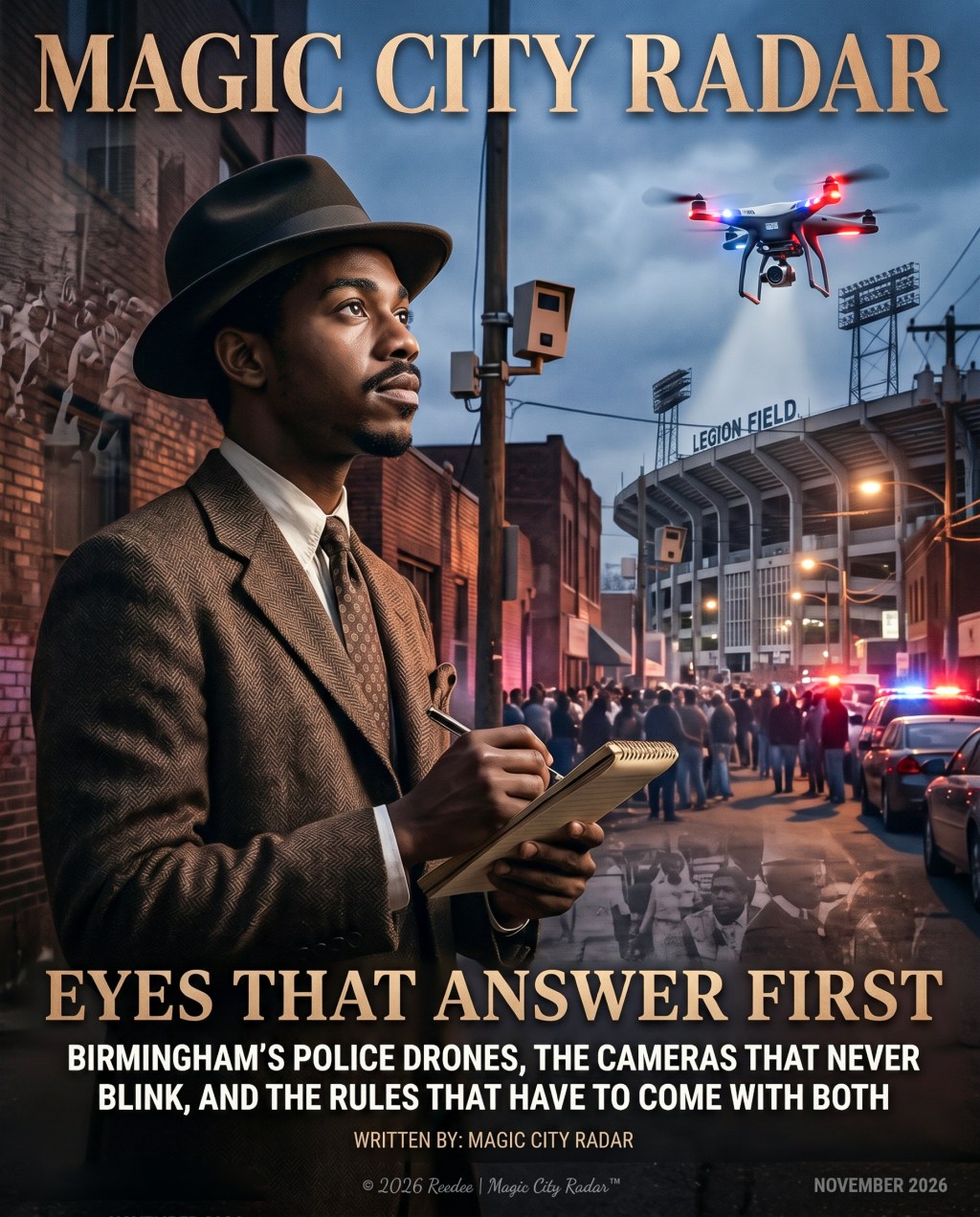
On November 10, the Birmingham City Council took up an ordinance to formally launch a Drone as First Responder program for the Birmingham Police Department. The idea is plain: when a 911 call comes in, a drone launches from a dock, flies to the scene, and puts live eyes on the emergency before the first patrol car can arrive — what is happening, how many people are involved, who is armed, which way did they run. Council President Darrell O’Quinn has made the speed case in public: in most cases the drone can be over the scene before an officer can physically get there.
The hardware is already bought. In May 2025, the council approved $1.5 million for sixteen DJI M4TD drones and equipment from SkyfireAI of Huntsville. The agreement now before the council is a second, separate deal — up to $1.5 million over three years — for Skyfire to support a first-responder operation built around eight drones and their docking stations. The ordinance still requires a final vote. But the direction is set: Birmingham intends to fly.
And here the city should pause and notice its own reflection. This fall, Alabama’s House Bill 429 took effect, making it unlawful for a civilian to fly a drone within 400 feet of a ticketed event — a first offense can cost $500 — and in October the City Council voted to give its own officers the citation book to enforce it, just in time for the Classic. The law exempts the police. The same government that will fine you for flying over Legion Field intends to fly over Graymont Avenue. A serious city does not hide from that sentence. It asks what would make both halves of it just.
The question Birmingham has earned the right to ask
Let us be precise about something: when Birmingham hesitates at a new instrument of state watching, it is not suffering from a fashionable anxiety. It is consulting its memory.
This is the city where a Black neighborhood was bombed so relentlessly for the crime of Black families moving in that it took a new name — Dynamite Hill. This is the city where four girls went to Sunday school on September 15, 1963, and did not come home. This is the city whose movement was photographed, infiltrated, catalogued — where the cameras of the state were never once pointed at the bombers with the diligence they were pointed at the marchers. Birmingham does not need a lecture on what it means to be watched by power. Birmingham wrote chapters of that book in its own blood.
So the question is never the simple one — should the city have eyes? The question, the one this city’s history obliges it to ask of every new instrument, is harder: Who holds the eye? Under what written rules? For how long does its seeing live, and who may look at it afterward, and toward what ends? A tool is never only a tool. Every technology handed to an institution becomes, over time, a picture of what that institution believes it is permitted to do. Which is why the terms matter more than the machinery — and why Birmingham’s recent record on terms is exactly what should sober every supporter of this program, this magazine included.
The exhibit: a policy that will not show itself
Birmingham does not buy its license plate readers from Flock Safety. As Mayor Randall Woodfin has put it himself: “We don’t even have a contract with Flock. We actually have a contract with Alabama Power.” The power company — which Flock has called its longest-standing reseller, and which has sold camera systems to more than eighty Alabama municipalities — mounts the cameras on its poles, powers them, and bills the city. In 2025, Birmingham expanded that arrangement to $9.7 million. By Flock’s own device records, 399 Flock devices were operating inside the city limits at the end of 2025, roughly 1,500 across the three-county metro, and more than 2,800 cameras run statewide.
Now attend to the detail that tells the whole story. Since March 2022, Alabama’s rules have required any agency capturing plate data to publish its license plate reader policy first. Birmingham has such a policy. In August, the department handed the written document to a reporter. It has never been published. Birmingham police have logged more than 419,000 searches of that system since 2022 — four hundred nineteen thousand acts of looking — and not one Birmingham resident can read the rules the looking is supposed to obey.
Hold that fact up to the light, because it is the fulcrum of this entire argument. The scandal is not the camera. The scandal is the silence around the camera: power exercised under rules the public is not permitted to see. And misuse, where the fences are invisible, follows as reliably as night. Thirty miles from City Hall, in St. Clair County, an audit this past July cost two officers their jobs — a Moody sergeant fired after investigators found he had used the system to track a woman he was interested in, and a Springville officer who resigned after searching for a member of his own family. The state law enforcement agency investigated both. To the record’s credit, no misuse case has been reported inside Birmingham’s own department. But a region does not get to call those two men aberrations when the systems around them run on unpublished rules. They are what unwatched watching produces, everywhere it is tried, given time.
The resistance is neither fringe nor partisan. Darrell Nance founded DeFlock Birmingham to count, in public, the cameras the city would not count out loud. In Montgomery, Republican State Senator Arthur Orr — a conservative’s conservative — is preparing legislation for 2027 to write statewide guardrails into law: warrant requirements for some searches, shorter retention, real penalties for abuse. When the mapper and the senator are demanding the same sentence — write the rules down and show them to us — the sentence is no longer an ideology. It is the city’s own unfinished business.
The distinction, and the conditions
This magazine supports the drone program. But let the support be argued, not merely announced, because the argument is also the standard to which the program must be held.
A license plate reader is a dragnet. It stands on its pole around the clock and records everybody — the grandmother bound for church, the father bound for work, the teenager bound for nowhere in particular — and it keeps the record. Nobody called. Nobody asked. Watching is the default, and the burden falls on the innocent to be uninteresting.
A first-responder drone is a dispatch. It sleeps in its dock until a citizen’s own call for help wakes it; it goes to the address the call came from; it looks at the emergency; it comes home. The watching is the exception, summoned by the community itself, and it ends when the emergency ends. On Graymont Avenue, that distinction is measured in the only currency those minutes accept: how long everyone — families and officers alike — had to be blind.
But a distinction that lives only in a press release will die there. If the drone is truly a dispatch and not a dragnet with better manners, the difference must be written into enforceable terms, and Birmingham should demand them before the first dock opens — not as decoration on the program, but as the price of it:
Publish the policies. Both of them — the plate reader policy the state has required in public since 2022, and the drone policy before the first flight rather than after the first controversy.
Publish the flight logs. Every launch, every address, every minute aloft, on a public dashboard, as the best-run programs in the country already do. If every flight answers a call, the log will say so, flight after flight, and the program will defend itself with evidence instead of assurances.
Keep the seeing short-lived and fenced. Footage that is not evidence should not grow old on a server. Nothing gathered answering a 911 call should drift into purposes nobody voted on.
Punish misuse as the breach it is. St. Clair County fired its officers. That is the floor. A public eye turned to private purposes should end careers and, where the law allows, bring charges.
None of this slows a drone by a single second. These are not obstacles to the program. They are what would make the program belong to Birmingham rather than merely operate above it. Mayor Woodfin unveiled a five-year plan this fall to drive down violent crime; a plan is only ever as worthy as the terms of the tools inside it. Birmingham should refuse to choose between the city that needs help to arrive in time and the city that remembers what unwatched power costs. It is the same city. It has always been the same city.
What say you, Magic City?
So here is where this magazine lands. Fly the drones. Answer the calls faster. See the scene sooner. Bring our neighbors and our officers through the next Graymont night with better information than fear. But write the rules in ink, in public, first — because a people who were watched on Dynamite Hill, watched at the church, watched at the march, do not hand any institution a new eye on credit. And a people who buried a neighbor this October do not refuse an eye that answers when they call.
Both of those things are true. They have always both been true. The program will be judged by whether Birmingham can hold them at once — and so, frankly, will the city.
Should Birmingham fly — and under what rules? The comments are open, and Radar is listening.

