How the Magic City Classic turned one Saturday in Birmingham into a $25 million family reunion — and why the whole city eats when the folks come home
Written by: Magic City Radar
You can smell the Classic before you can see it.
It comes up off the grills in Graymont on a Thursday — hickory smoke and somebody’s uncle’s secret rub — and it settles over the west side of Birmingham like the whole neighborhood exhaled at once. By Friday it has climbed the fences of Legion Field and married itself to the brass warming up two streets over. By Saturday morning, it owns the city. The Magic City Classic does not arrive in Birmingham. It rises up out of it, the way it has every autumn since before anybody alive can remember being asked permission.
This is the largest HBCU football game in the nation — Alabama A&M’s Bulldogs against Alabama State’s Hornets, a quarrel so old and so beloved that it stopped being a rivalry a long time ago and became a kinship ceremony with a scoreboard. They first played it in 1924. It has lived at Legion Field since the 1940s, through everything Birmingham has been and everything Birmingham has tried to become. Grandmothers who watched it in wool coats bring grandbabies who watch it in custom sneakers. The game is the excuse. The gathering is the event.
And the gathering, it turns out, can be counted.
THE ARITHMETIC OF A HOMECOMING
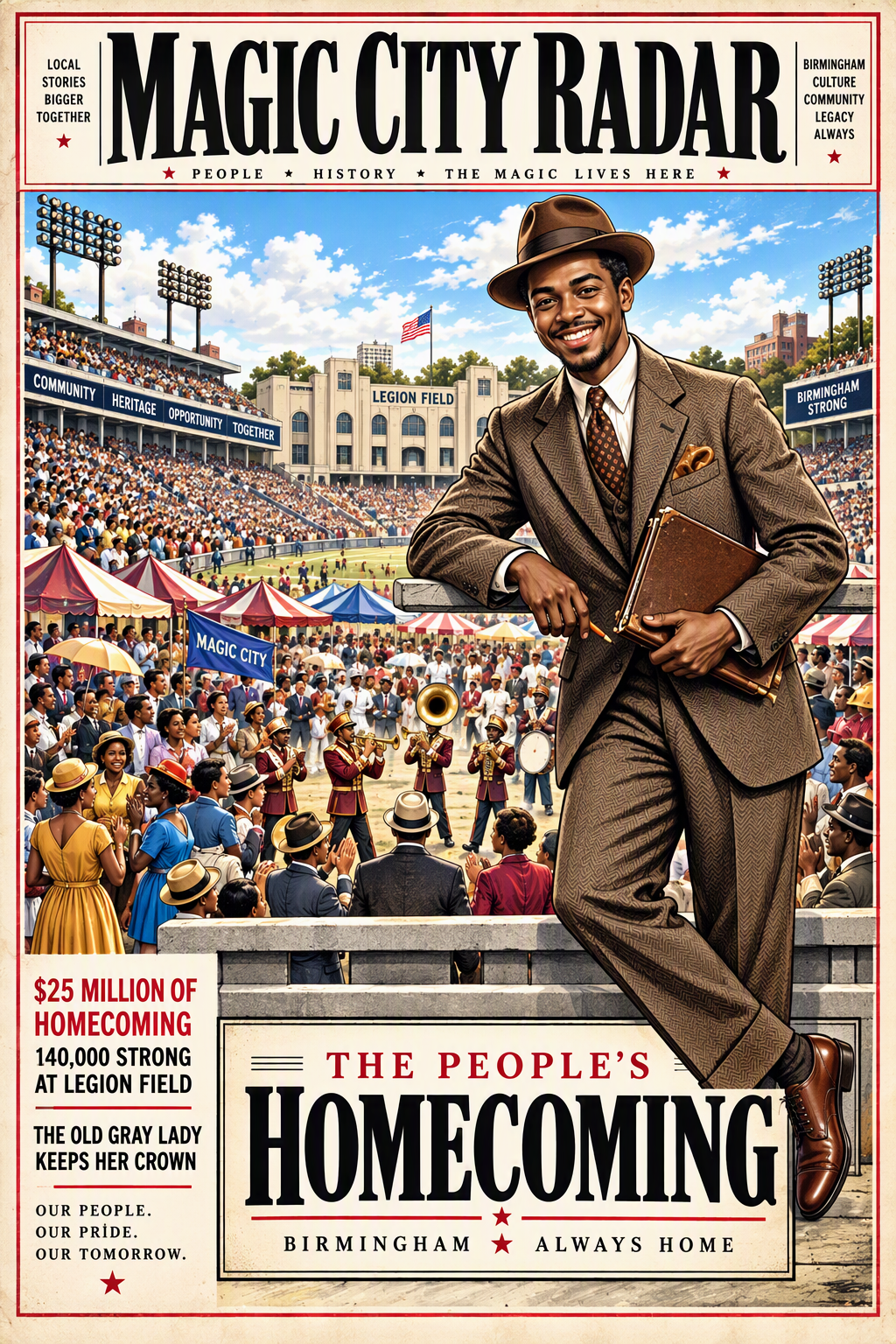
The Classic is expected to pour an estimated $25 million into Birmingham’s economy this week, according to Classic Executive Director Perren King — up some $7 million from a decade ago. Read that number the way the folks who generate it would read it. It is not a tourism statistic. It is hotel rooms booked three and four nights deep by people who once booked one. It is restaurant lines out the door. It is vendors who plan their whole fall around this week, and family budgets that plan their whole year around it.
They come from 34 states. King estimates 140,000 people will be on the grounds at Legion Field on game day — cooking, visiting, promenading, remembering — and last year just under 70,000 of them filled the stadium itself. This year the aim is 75,000. The stadium crowd alone would make this a major American sporting event. The stadium crowd is barely half the story.
Follow the money the way it actually walks. It walks downtown and Uptown first, into hotel clusters running at full occupancy, where the transient lodging taxes stack up like cordwood for the city. Then it walks home — into the Historic Fourth Avenue Business District and the Civil Rights District, where Black-owned lounges, diners, barbershops, and storefronts see the heaviest foot traffic of their autumn, because this is the week the alumni come back to the streets that raised them and spend like they mean it. Then it fans out west, into Graymont and the neighborhoods pressed up against Legion Field, where the economy puts on an apron: pop-up retail on front lawns, barbecue men selling plates out of smokers the size of Buicks, families running yard-parking operations with the precision of air-traffic controllers, service stations doing a month of Saturdays in a day.
Even the corporate money has learned to sit at the family table. Initiatives like the Regions Bank of Ideas Challenge fold student entrepreneurship and local business development into Classic week, so the pipeline runs both ways — the banks come to the reunion, and the reunion’s children leave with business plans.
“When you get to an area of around $25 million economic impact,” King told reporters, “that’s something where it’s really serving more of a public purpose.” He called it necessary. He is right, but the number is not the deepest truth of it. The deepest truth is that this economy runs on affection. People do not spend this kind of money, or burn this kind of vacation time, on an event. They spend it on a homecoming.
THE BANDS PLAY, AND THE PEOPLE ANSWER
Ask the wrong question around Legion Field and somebody will correct you with love: baby, the game is at 2:30, but the Classic is at halftime.
When Alabama State’s Mighty Marching Hornets and Alabama A&M’s Marching Maroon and White take the field, the stadium changes its religion. This is not entertainment between halves of a football game. This is two institutions arguing in brass and drumline about who loves their people louder — and the fifth quarter, that glorious after-the-game refusal to go home, stretches the argument until the lights themselves get tired. For a great many of the 140,000, the band showcase is not an attraction of the Classic. It is the Classic, and the football is the family business that pays for the hall.
This matters more now than it did a generation ago, and everybody under the tents knows it. College football at the top has become a stock exchange — NIL collectives with nine-figure appetites, transfer portals spinning like revolving doors, conferences realigning according to television maps drawn in boardrooms far from any campus. Players are assets. Fans are content. And yet here, on the west side of Birmingham, the largest HBCU game in America keeps proving the opposite thesis in front of 140,000 witnesses: that a football program’s real wealth was never in its TV contract. It is in whether your grandmother’s roommate from freshman year still saves you a seat. It is in heritage you cannot transfer, identity you cannot portal out of, fellowship no collective can buy.
The Classic’s cultural capital is not a metaphor. It is the reason the hotels fill. Heritage is the draw; the $25 million is just heritage, counted.
A REUNION THAT STARTS ON TUESDAY
Somewhere around midweek, the tailgates begin claiming their ground — canopies up in Graymont days before kickoff, grills seasoned, extension cords run like family trees. What assembles around Legion Field is not a parking lot with food. It is an outdoor family reunion that doubles, quietly and completely, as the most effective professional networking event in Black Alabama. Deals get sketched on napkins. Internships get promised over ribs. Pastors, principals, line brothers, line sisters, council members, cooks — the whole architecture of a community reassembles itself in folding chairs, one Saturday a year, on purpose.
That is the thing the spreadsheet cannot hold: the Classic is where Birmingham’s Black professional class, working class, church class, and coming-home class are all the same class. Everybody’s somebody’s people. The week has grown from a weekend into a full civic season — concerts, parties, pep rallies, the downtown parade — but its center of gravity never moved. It is still the moment the dispersed family stands in one place and looks at itself and says: we are still here, and we are still us.
THE OLD GRAY LADY KEEPS HER CROWN
Which is why the argument about where this game belongs is not really an argument about stadiums.
Protective Stadium, up at the BJCC, is new and handsome and modern in all the ways brochures love — and it holds roughly 45,000 people. The Classic regularly draws 65,000 ticketed souls and more, on top of a tailgate city that needs acres the way a church needs a parking lot on Easter. You cannot shrink a homecoming to fit a floor plan. Moving the Classic to Protective would not relocate it. It would amputate it.
So the game stays with the Old Gray Lady — Legion Field, nearly a century old, still standing in the west side neighborhoods that grew up in her shadow. The city has put real money into her bones: FIFA-grade turf, new LED lighting, targeted repairs meant to keep her worthy of the crowds she still commands. The deferred maintenance is real, and the debate about her long-term future is honest. But the four-year agreements among the City of Birmingham, the Alabama Sports Council, and the two universities keep landing in the same place, because the alumni and the institutions keep saying the same thing: this game belongs in west Birmingham, in the community that made it, on the ground where the smoke rises first.
A stadium is concrete and debt service. A home ground is memory with an address. Birmingham, to its credit, keeps choosing the address.
SATURDAY, 2:30
So here is the 85th edition of it: Alabama A&M and Alabama State, Saturday at 2:30 p.m., Legion Field, with 140,000 of the folks on the grounds and the whole week of the city arranged around it like chairs around a table. The economists will file their report, and it will say $25 million, and it will be accurate, and it will be the smallest true thing that can be said.
Because what the Classic really generates cannot be deposited. It generates the barber who does his best business of the year in the district his grandfather cut hair in. It generates the freshman who watches the Maroon and White hit the field and understands, all at once, what her tuition is actually buying. It generates the family that scattered to thirty-four states standing shoulder to shoulder in the Alabama sun, singing, eating, arguing about 1987, being — for one week — un-scattered.
The game will end. Somebody will win, and the winning side will talk about it for a year, and the other side will talk about the refs for slightly longer. But the people will do what they have done since 1924: they will feed each other, fund each other, remind each other who they are — and then they will go back out into the world carrying Birmingham with them.
The Classic is not Birmingham’s biggest weekend.
It is Birmingham, at its biggest, coming home to itself.

